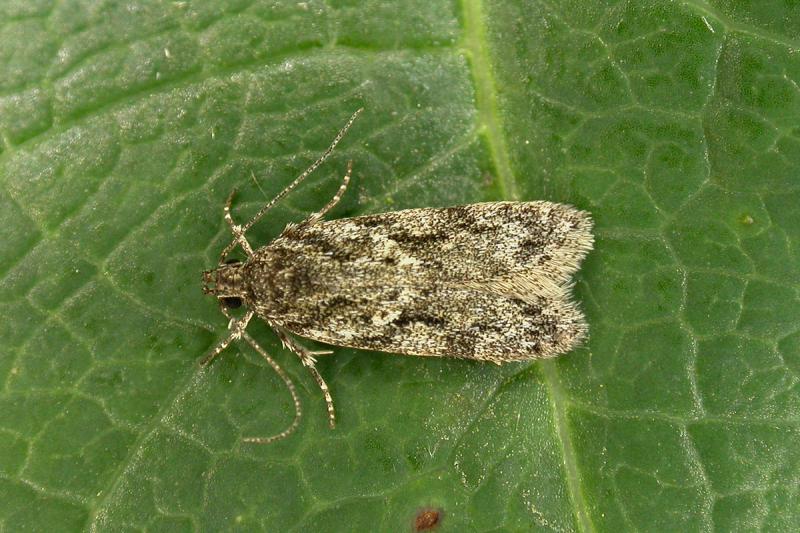
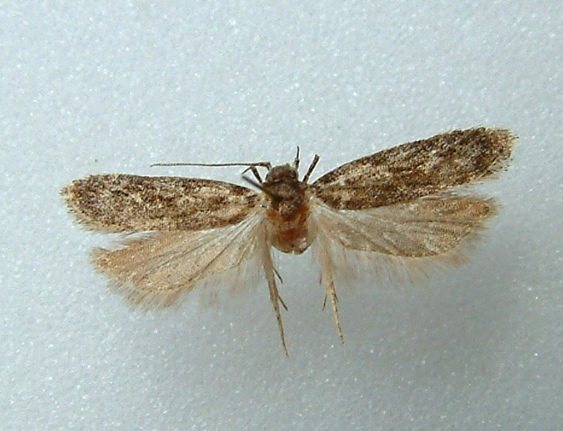
35.102 Gelechia muscosella Zeller, 1839

Status and Distribution


Scarce, occurring at several well scattered sites in eastern and south-east England such as the broads and fens of East Anglia, a golf course with a large wetland area in Suffolk, coastal areas of Kent and a few wetland nature reserves in South Yorkshire, two of which were former industrial sites.

More recently reported from several new or previously overlooked sites in Berkshire, Hertfordshire, Huntingdonshire, Middlesex, Nottinghamshire, Oxfordshire and South Wales.

National Status: pRDB 3
Bradley & Fletcher no: 803
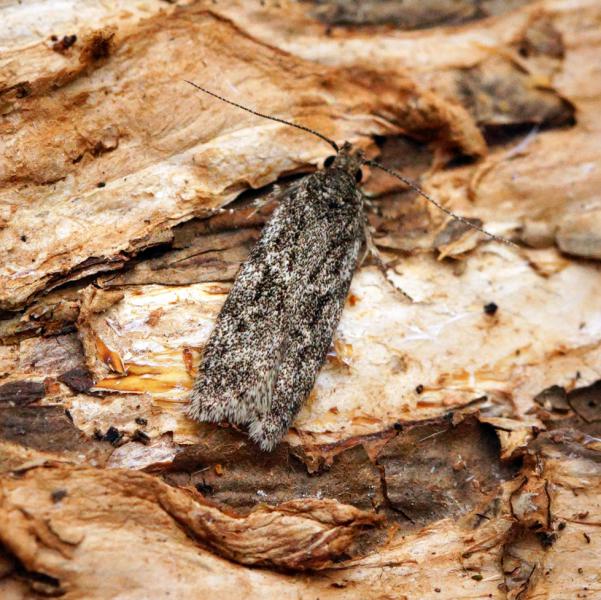
Photographer: © B Sale
Location: Hertfordshire

Provisional map

NHMSYS0000502707
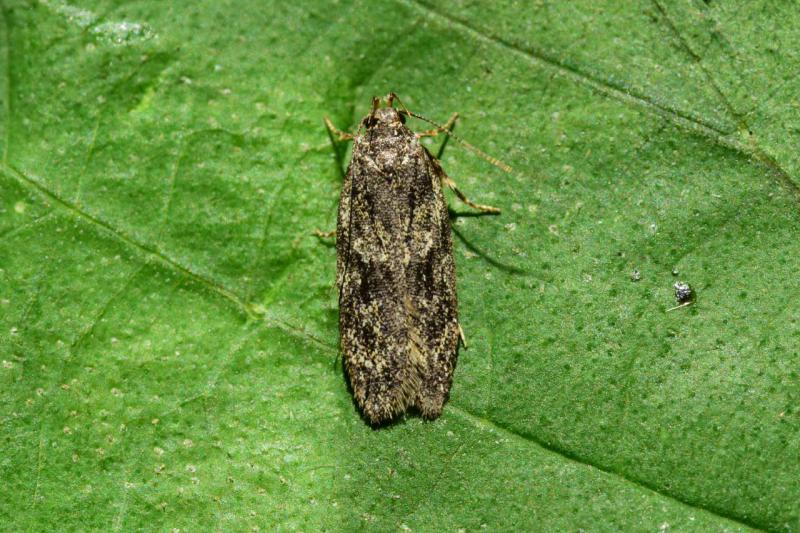
Imago

Gelechia muscosella, Herts (Photo: © B Sale)       

Gelechia muscosella 19.6.25 Cardiff (Photo: © G Tordoff)

Pupa

Set Specimens

Gelechia muscosella Kent 1985 courtesy BENHS (Photo: © S Palmer)

Foodplant and Larval Feeding Signs

On Salix cinerea (grey willow) and possibly also Salix caprea (goat willow) or Populus spp. (poplar).

In Britain feed in female and male catkins and possibly spun shoots of Salix spp (see details under 'Finding the moth').

In Germany during April 2015 feeding in catkins of Salix caprea was confirmed with the moth bred.

Habitat

Associated with wetland sites such as Fenland, wet, scrubby areas on coastal shingle, disused quarries and damp estuarine field edges.

Finding the Moth

Larva: found and bred from both female and male catkins of grey willow in 2026. The moth appears to have a preference for larger mature trees where the lowest branches are at least one to two metres above the ground.

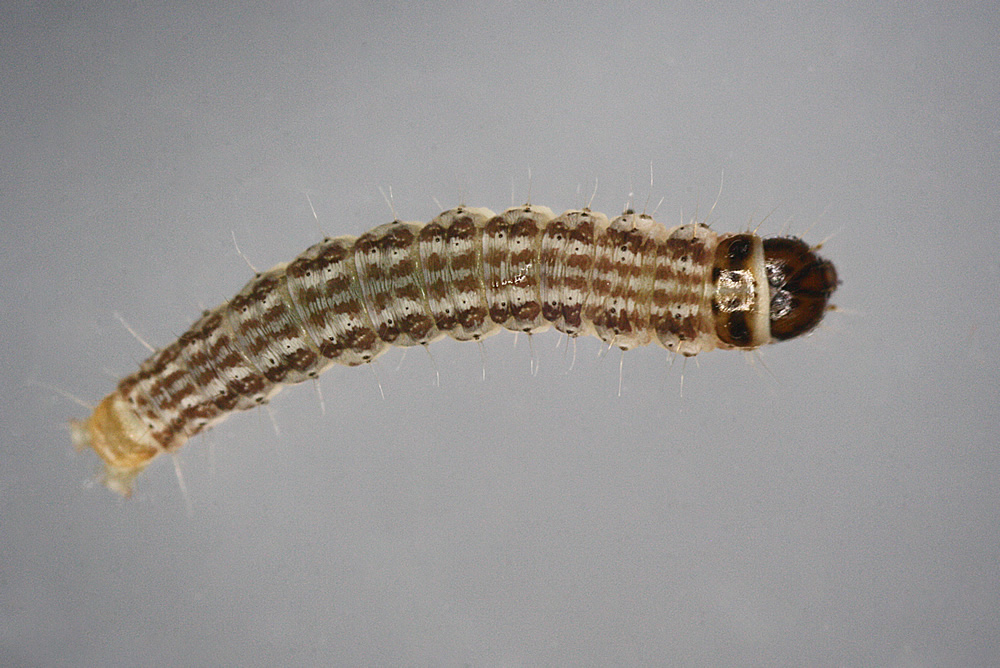
The final instar larvae are considered likely to be very similar to those of G. sororculella. Based on a lmited number of bred larvae of G. muscosella and G. sororculella, Beavan & Heckford (2026) suggest the longitudinal abdominal lines seem more reddish brown, and the body whiter in muscosella but comparative material would be needed. If the body has a greenish tinge then it should prove to be sororculella. The most likely useful identification feature seems to be the colour of the prothoracic plate - in sororculella it is unmarked and yellowish brown, while in muscosella it is the same colour but has a transverse central blackish brown band and bisected by the medial division with an elongate blackish brown mark either side of that division on the posterior edge.

Photographs taken on 7th April 2015 in Bayern, Germany, of a larva on a Salix caprea catkin ( http://www.lepiforum.de/lepiwiki.pl?Gelechia_Muscosella ) demonstrate the larva was subsequently bred through.

Adult: can be found resting on the trunks of mature sallows with large trunks or disturbed from the foliage; also comes to light.

Similar Species

Because of the large range in size (wingspan 12-17mm), smaller specimens, particularly if worn, might be confused with other dark grey species such as Carpatolechia notatella, which has a prominent black basal spot on the forewing.

G. muscosella has the upperside of the basal three segments of the abdomen an ochreous-yellow colour, a feature also present in G. nigra (see below) and G. cuneatella. The latter has has more elongate forewings and the second segment of the labial palps triangular in shape.

G. sororculella lacks the abdominal ochreous colouring and usually has a black spot at one third on the forewing broadly surrounded with white. The narrowly white-ringed dot in G. muscosella, if present, is in the middle of the wing.

There is a slight overlap in size with the generally larger Gelechia nigra which also has the ochreous yellow abdominal segments. The forewing of this species is black in colouration compared to the greyer mottled forewing of G. muscosella.  If there is any doubt then dissection is recommended.

April, May
June, July, August

Single brooded with the meagre number of records suggesting a flight period during June, July and occasionally August.